Start with a useful working record
Your business received more enquiries this month. That sounds encouraging, but it does not tell you whether the extra interest became suitable work, accepted quotes or completed jobs.
A useful sales tracker follows the journey far enough to answer those questions. It also shows where enquiries are waiting, so you can decide what needs attention before spending more to attract them.
You do not need a dashboard full of charts. Start with consistent definitions, a few counts and one place to record the next step.
Start by deciding what counts as an enquiry
An enquiry is a genuine request about a service your business might provide. Count the request once, even if the person follows up by phone after completing a website form.
Exclude obvious spam and test submissions. Decide how to handle repeat work: a new request from an existing customer can be a new opportunity, but another message about the same quote should not inflate the enquiry count.
Write down your definition. Changing it halfway through a reporting period makes comparisons harder to trust.
Record the arrival channel separately from the original source. “Phone” tells you how someone contacted you. “Referral from an existing customer” tells you how they found you. If you do not know the source, record “unknown” rather than guessing.
Track whether anyone responded
Count enquiries that received a meaningful first response. An automatic receipt can confirm delivery, but it should not be counted as a personal assessment of the request.
Response coverage = enquiries with a meaningful response ÷ enquiries received × 100.
For response time, choose a consistent starting and ending point. For example, measure from receipt to the first useful human reply. State whether you use elapsed time or business hours, especially when requests arrive overnight or at weekends.
The median is the middle response time when you arrange the times from shortest to longest; if there are two middle values, add them together and divide by two. It helps stop one unusually long wait from dominating your headline figure. Still review the overdue requests individually. An attractive average does not resolve an unanswered customer.
Separate suitable enquiries from total enquiries
A qualified enquiry meets your stated criteria for moving forward. Those criteria might include the service required, location, scope and a realistic fit with your availability.
Qualification should describe an actual decision, not simply a person who replied.
Qualification rate = qualified enquiries ÷ enquiries assessed for suitability × 100.
Keep enquiries still awaiting assessment visible. Leaving them out of the total used in this calculation is reasonable only when you clearly show how many remain unassessed. Otherwise a busy backlog can disappear behind a flattering percentage.
If many requests are outside your service area, investigate the message or source attracting them. If suitable requests are waiting for assessment, investigate the handoff. Those are different problems.
Count assessments quotes and decisions separately
Some services need a visit or discovery call before a quote. Others can be priced from a short conversation. Measure the stages your business actually uses.
Where appointments matter, distinguish appointments arranged from appointments completed. A booking alone does not show that the assessment happened.
For quotes, count opportunities quoted, not every document revision. Keep the version history, but do not turn one revised proposal into three sales opportunities.
Two useful measures answer different questions:
- Quote-to-acceptance rate: accepted opportunities divided by quoted opportunities in the selected group.
- Decided-quote win rate: accepted opportunities divided by accepted plus declined opportunities in that group.
The second measure excludes pending decisions. Always show the pending count beside it. Ten accepted quotes and no declines do not establish a perfect sales process if another 40 are still waiting.
Follow accepted work through completion
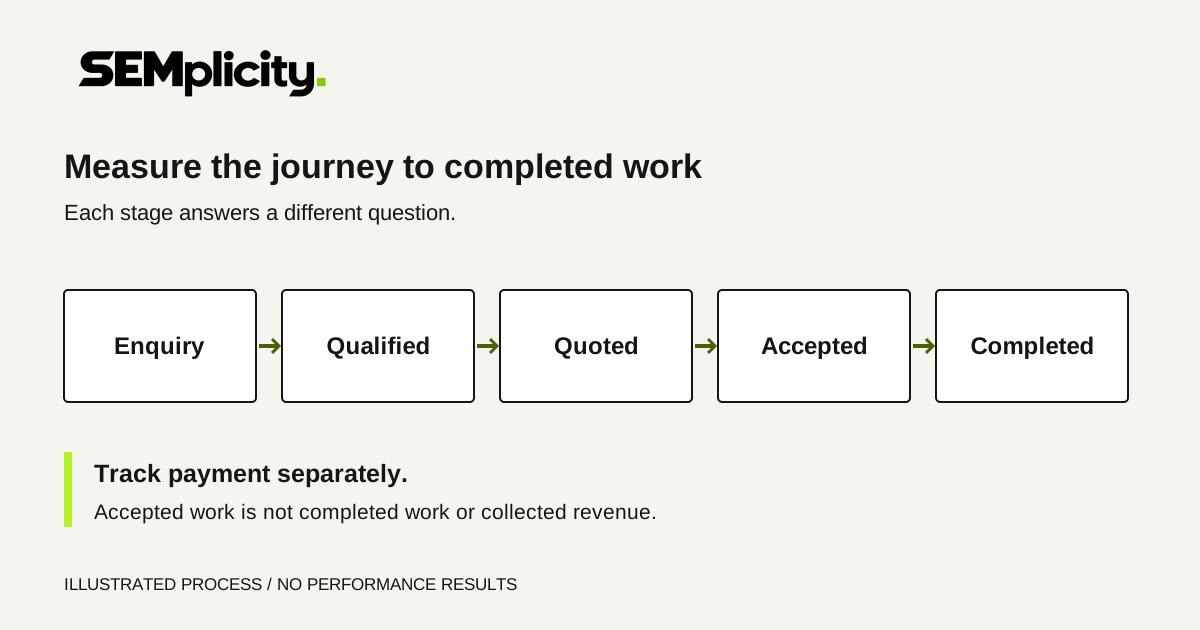
An accepted quote is an important milestone. The work may still need scheduling, delivery, invoicing and payment.
Keep these statuses separate:
- Accepted: the customer has completed your actual acceptance process.
- Completed: the agreed work has been delivered under your completion definition.
- Invoiced: an invoice has been issued.
- Collected: payment has been received and recorded.
Quoted value is potential work, not collected revenue. Collected revenue is also not profit: delivering the service involves costs. Use your accounting records for financial reporting and avoid treating a lead tracker as a substitute.
Compare the same group of enquiries
Dividing this month's accepted jobs by this month's new enquiries can mix unrelated groups. Some accepted jobs may have started months earlier, while recent enquiries have barely had time to receive a quote.
Instead, follow a cohort: enquiries received during a defined period. Report their progress as of a stated date. Keep a separate activity report for work completed during the current month.
Fictional illustration, not a benchmark: A business receives 40 genuine enquiries in one cohort. By the review date, it has assessed all 40, qualified 24 and quoted 20. Eight quotes are accepted, six declined and six pending. The quote-to-acceptance rate is 8 ÷ 20 = 40%. The decided-quote win rate is 8 ÷ 14, approximately 57%. Neither number predicts the pending outcomes. Five accepted jobs are completed; the other three remain in delivery.
Use the numbers to choose one improvement
Review the counts alongside the actual records. Look for unanswered enquiries, delayed assessments, quotes awaiting internal work and accepted jobs without a delivery handoff.
Record loss reasons only when known. “Customer chose another provider” is different from assuming that an unanswered quote was too expensive.
Try one specific change, such as assigning a backup owner for new requests. Then compare two groups of enquiries after the same amount of follow-up time, long enough to cover your usual quoting and decision process. Use the same definitions and show any quotes still awaiting a decision. Note changes in service mix, capacity and sources before attributing results to that change.
Your starting worksheet
For one enquiry cohort, record: dates covered; review date; total enquiries; assessed; qualified; quoted; accepted; declined; pending; completed; and unanswered requests. Add your definitions and a named owner for the review.
This worksheet does not set a target percentage for turning enquiries into customers. Its purpose is to help you understand your own process, identify unfinished work and make a more informed next decision.
Editable enquiry group worksheet
Use the same enquiry group and definitions throughout. Complete the entries below; blank fields are not performance results.
| Field | Editable entry |
|---|---|
| Dates covered and review date | [Enquiry period start/end; review date] |
| Total and assessed enquiries | [Total]; [assessed] |
| Qualified and quoted opportunities | [Qualified]; [quoted] |
| Accepted declined and pending | [Accepted]; [declined]; [pending] |
| Completed and unanswered | [Completed]; [unanswered] |
| Definitions and review owner | [Definitions]; [name/role] |
Define the stages before counting them
- Enquiry: a genuine request for the service. Exclude tests, obvious spam and duplicate attempts about the same opportunity.
- Qualified enquiry: the request fits the service, real coverage and ability to engage. Agree the rules; do not silently use a budget threshold.
- Booked work: work accepted and scheduled under the business's own booking definition. A quote request alone does not qualify.
- Completed work: the agreed work was performed. Keep cancellation and rescheduling statuses separately visible.
- Collected revenue: payment received, with a consistent treatment of tax, refunds and timing. An issued quote or invoice is not cash collected.
Record the definition owner and date. If the rules change, annotate the change instead of comparing incompatible totals as though nothing changed.
Create one small operational record
Use these column headings: opportunity reference; enquiry date; reported source; campaign label if known; service/coverage fit; qualification status and reason; booking date; cancellation status; completion date; collected amount in CAD; last review date; and next action owner. Keep unknown source as unknown rather than guessing.
Fictional example: opportunity EX-014, enquiry 3 October, source stated as Google Search ad, fit confirmed, booked 5 October, work scheduled for 12 October. Until completion is confirmed, leave that date blank; until paid, do not enter collected revenue. This is an invented record, not SEMplicity customer data.
Use anonymous references in shared reports. Keep any contact details in the authorized operational system, not in public worksheets or analytics URLs. Decide access and retention with the accountable business owner before collecting data.
Separate contact actions from real conversations
List each measured action and what it actually proves. Google supports separate website, phone and offline conversion actions, as described in its conversion-source overview. A button click, accepted submission and qualified enquiry should not share an ambiguous label.
A phone-link click may not become a connected call. Google's phone tracking guidance explicitly distinguishes mobile number clicks from measured calls. Even a connected call may concern an unsuitable service. Check the event definition and operational outcome before reporting a booking.
Consistent source, medium and campaign labels can help identify referring campaigns; Google's URL guidance explains this. Labels alone do not install analytics or recover missing data. Do not put names, emails or enquiry text in those labels.
Compare matching groups and remove duplicates
Choose enquiries first received in one period and follow those same opportunities through later outcomes. For example, report the October enquiry group as of a stated November review date. Do not divide bookings received this week by unrelated enquiries received this week when the sales cycle spans weeks.
For repeat form submissions or a follow-up call about the same request, update the original opportunity. Retain genuinely separate jobs separately, using an agreed rule. Exclude authorized test enquiries from business totals. Keep pending outcomes visible: an unanswered request is not automatically lost, and an uncompleted booking is not completed revenue.
Calculate only what your records support
Fictional arithmetic in CAD, before tax; not a benchmark or forecast. For one matching group, assume CAD 1,200 ad spend, CAD 300 other allocated marketing costs, 20 unique enquiries and 5 bookings. Ad cost per enquiry is 1,200 / 20 = CAD 60. Booking rate is 5 / 20 = 25%. Ad cost per booking is 1,200 / 5 = CAD 240. Allocated marketing cost per booking is (1,200 + 300) / 5 = CAD 300.
These are observed costs in an invented example. They do not establish profit, customer value or what another month will cost. State which fees are included. If enquiries or bookings are zero, the corresponding per-unit result is not defined; show the counts and costs instead. Do not divide by zero or invent a substitute result.
Reconcile, then choose one corrective action
At a recurring review, compare operational counts with platform reports. Note reporting period, time zone, conversion definition, attribution window, attribution model and known reporting delay. Platforms may credit overlapping interactions; do not add their claimed conversions together as unique customers. Attribution assigns credit under rules; it does not prove the advertising caused the sale.
Investigate mismatches before changing budgets. Many contact clicks but few real enquiries suggest a journey or measurement issue. Suitable enquiries without bookings suggest checking follow-up, fit, offer or scheduling. Consent gaps, cross-device journeys, missing sources and small samples limit conclusions.
Choose one next action with an owner and review date. Read the landing-page readiness guide if contact friction is the concern, or the channel-choice guide before a new investment. Review the Google Ads or Meta advertising scope for relevant support. Account setup, uploads and integrations need a separate approved implementation.
Common measurement questions
Does an accepted quote count as completed work?
No. Acceptance, completion, invoicing and collected payment are separate statuses.
What should I do with quotes still awaiting a decision?
Show the pending count. Quote-to-acceptance uses all quoted opportunities in the selected group; decided-quote win rate uses accepted plus declined opportunities.
Turn the review into a working follow-up process
Use the enquiry-to-customer follow-up guide to assign stages, owners and next actions. Copy the worksheet above into your approved working document; this page does not collect your entries.
Sources & review notes
Platform-specific points below were checked against these primary sources on 17 October 2026. Recommendations and fictional examples are editorial judgement, not platform requirements or performance forecasts.
- Google: Different ways to track conversions
Opened 17 October 2026. Supports distinct website, phone and offline conversion actions. No account configuration is prescribed here.
- Google: About phone call conversion tracking
Opened 17 October 2026. Supports distinguishing mobile phone-link clicks from calls, and separate call measurement methods.
- Google Analytics: Campaign URL parameters
Opened 17 October 2026. Supports consistent campaign source, medium and campaign labels. Tagging alone does not configure measurement.
Business eligibility, product controls and policies can change. Verify the requirements that apply to your actual account and industry before implementation.
YOUR NEXT STEP
Try the working record.
Copy the enquiry group worksheet into your approved working document. Use consistent definitions and choose a named review owner.